
Friction Circle - Part 1
For my first blog post on this site, I wanted to start with explaining one of the key fundaments of driving a car quickly, which is understand the grip thats available. To drive fast around a race circuit the driver needs to be able to exploit all the available grip, maximising braking, corner speed and acceleration to achieve those ultimate lap times. It’s more than just getting the racing lines correct, to go fast, we must understand how the tyres grip the tarmac.
Friction Circles are way of representing how the load or forces are being applied to a tyre as it’s in contact with the tarmac, and the level of grip that is available. In Part 1 we`ll cover the basics of thinking of the grip in terms of the Friction Circle, and then we`ll build on this concept in Part 2 and Part 3, to see how we can use this to our advantage.
Think of a simple circle around a central point, forces apply forwards (up) and backwards (down) with acceleration and braking, this is what you feel in the car, pushing you back in the seat as you accelerate, or pushing you forwards against the harness or seat belts as you brake, and side to side with cornering forces pulling you left or right.
Your tyres only have a certain amount of grip available, we represent this as the outside of the circle. Maximum accelerating grip can be represented as upards arrow to the edge of the circle, or maximum cornering grip represented as an arrow to one side or the other. For the purposes of this section, we`ll consider the distance from the central point of the cirle to the edge as 1.0
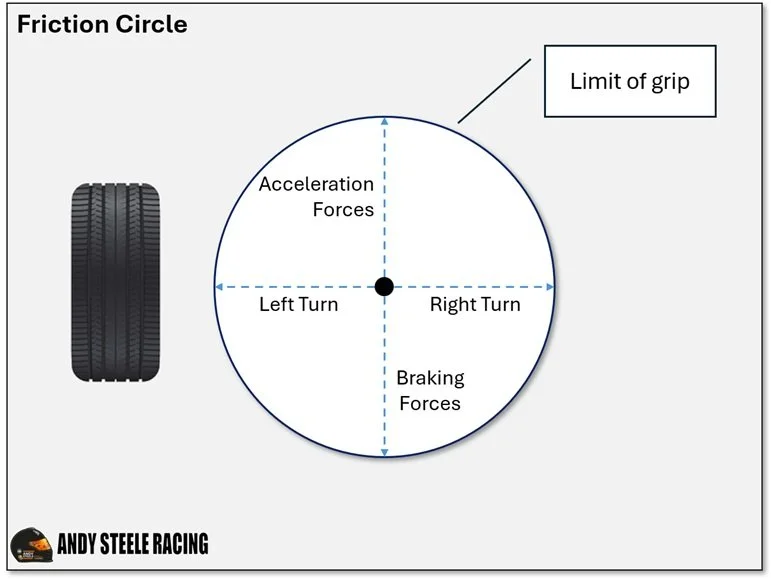
Friction Circle representing available grip for Acceleration, Braking and Steering.
If we Accelerate to the maximum level of grip thats available, we represent this as an Arrow from the centre of the circle upwards to the edge of the circle. If we Steer to the maximum level of grip thats available, we represent this as an Arrow from the centre of the circle sideways to the edge of the circle. Now, if we tried to do both maximum accerlation and maximum steering at the same time, we’d apply both those forces at the same time, the resulting force on the tyres is outside the circle (which represent maximum available grip) so at this point we are asking too much of the tyres and are sliding.
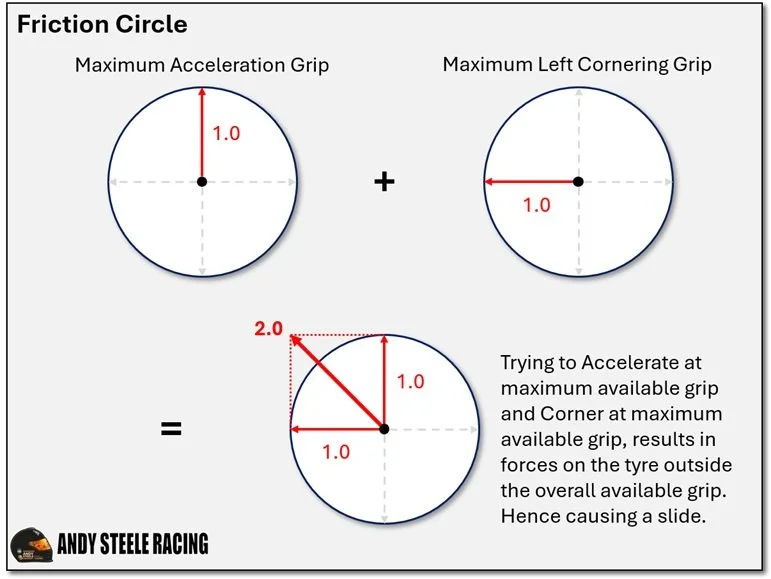
Three Friction Circles, representing maximum acceleration forces, maximum corning forces, and the result of adding these forces together.
So to maximise the grip what we want to think about is the balance between acceleration or braking foces and turning forces. In the simplest case we brake only when in a straight line, then turn into the corner when off the brakes, then accelerate when the steering is straight. But what we want to do is maximse the grip, so as we start coming off the brake we can start to turn in, then as we start reducing the steering we can start to accelerate, trying to keep those resulting forces flowing around the edge of the Friction Circle.
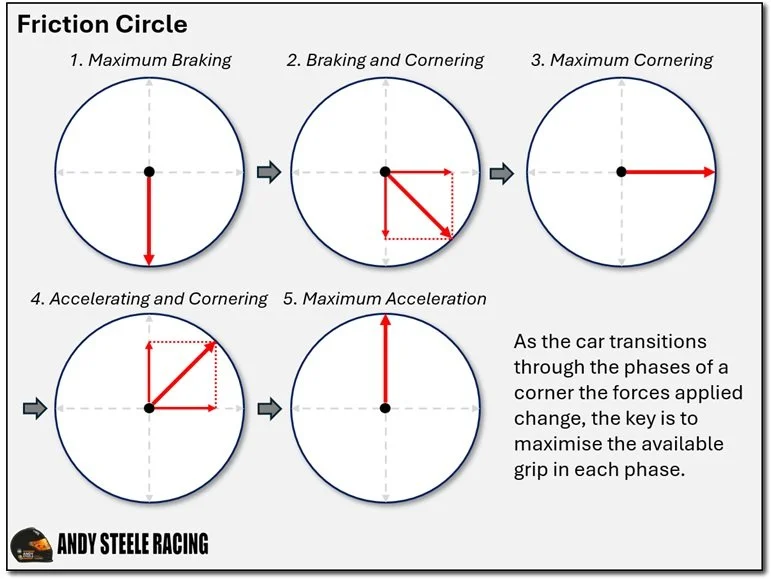
Five Friction Circles representing progression from Braking, to turning into a corner, peak steering mid corner, progressing acceleration through second phase of the corner, to full acceleration.
Come back for Part 2, where we`ll dig a bit deeper into the Friction Circle concept, and then Part 3 for how we can start to use this to our advantage to have more grip, and reduce lap times.
